The Battle of Stalingrad: Defeat of Evil
30.4.2025, 23.01.28
28 JUNE, 1942. OPERATION BLAU BEGINS.
Since the start of Operation Barbarossa - the largest invasion in human history and invasion of the Soviet Union by Nazi Germany - the Red Army has been pushed back to the Volga river. Almost.
The Soviet Union had been gravely ill-prepared at the start of the offensive. In the first three weeks, more than 3,500 tanks, over 6,000 aircraft, and two million men had been lost.1
From the start, it had been Germany's plan to sever the Soviet Union across the Volga river and occupy the Caucasus to get desperately needed oil to continue the advance. 14 months later, they had largely succeeded, capturing the Baltics, Ukraine, Belarus and several major cities including Leningrad, Rostov-on-Don, and Smolensk - where over 300,000 men had been captured.1
At this point, the war could be won or lost, something German leadership was very well aware of. The Axis had been spread thin due to fighting on three fronts and the sheer enormity of Soviet Union. On June 1st, 1942, Hitler even remarked to his generals:2
Wenn ich das Öl von Maikop und Grosny nicht bekomme, dann muss ich diesen Krieg liquidieren
Translation:
If I don't get the oil of Maikop and Grozny, then I must terminate this war
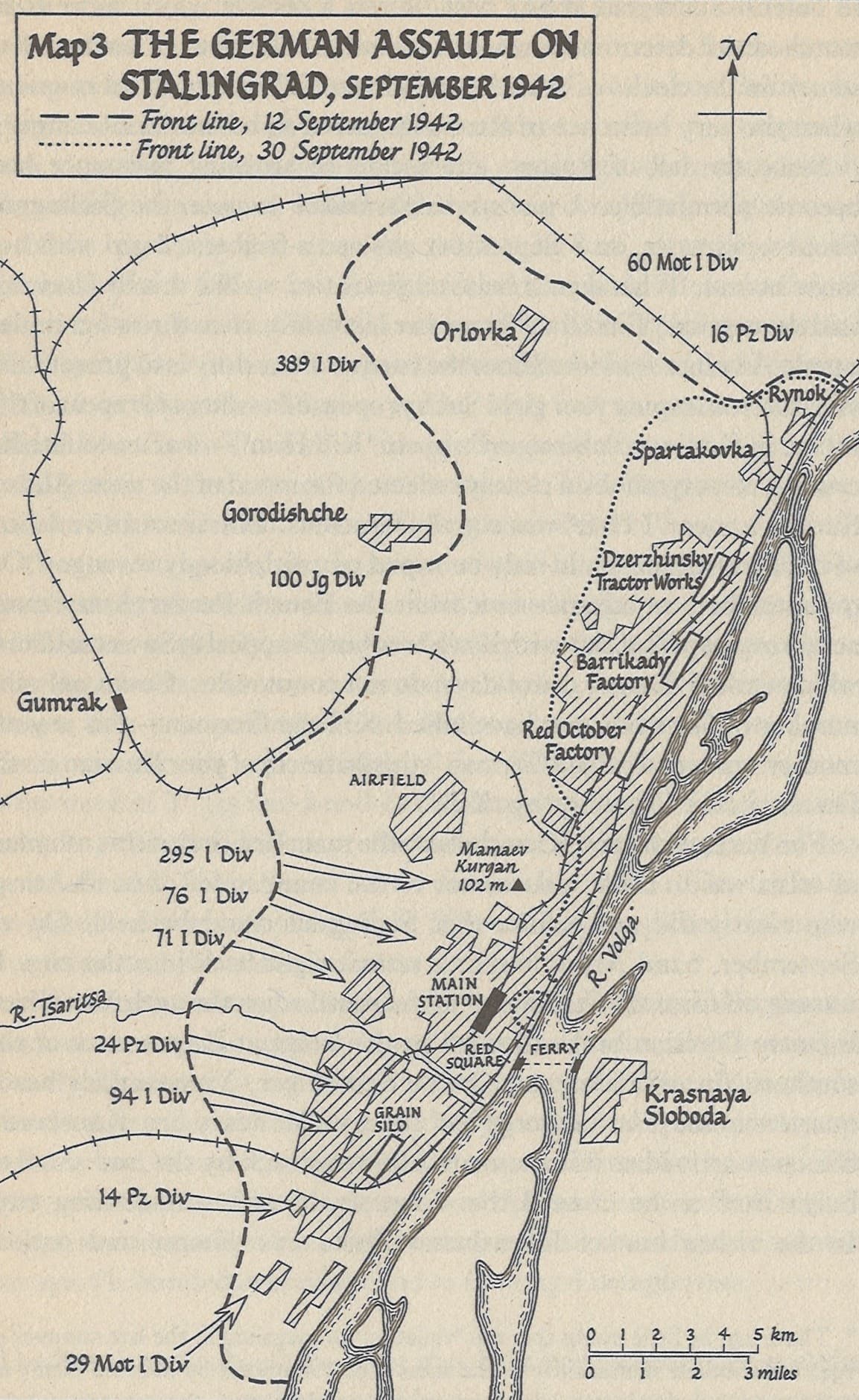 The Axis advance on Stalingrad in September 1942. Only a few square kilometers of the city are still within Soviet control. Image credit: Beevor, Antony, Stalingrad
Relentless defense
The battle of Stalingrad turned out differently than the Axis had expected. Although advancements were initially gained, as seen in the map above, the Soviets fought back relentlessly under the leadership of Stalin, who, on July 28 issued order no. 227. In this order Stalin promised severe consequences for those surrendering or deemed to show cowardice. This included on-the-spot execution or relocation to shtrafbats, which were units specifically made for extremely dangerous tasks at the front, such as mine clearing during attacks.3,4
We can no longer tolerate the fact that the commanders, commissars and political officers allow several cowards to run the show at the battlefield, that the panic-mongers carry away other soldiers in their retreat and open the way to the enemy. Panic-mongers and cowards are to be exterminated at the site. From now on the iron law of discipline for every officer, soldier, political officer should be – not a single step back without order from higher command. Company, battalion, regiment and division commanders, as well as the commissars and political officers of corresponding ranks who retreat without order from above, are traitors of the Motherland.
[...] The military Councils of the fronts and first of all front commanders should:
[...] Form within each Front 1 to 3 (depending on the situation) penal battalions (800 personnel), where commanding, senior commanders and political officers of corresponding ranks from all services, who have broken discipline due to cowardice or instability, should be sent. These battalions should be put on the more difficult sections of a Front, thus giving them an opportunity to redeem their crimes against the Motherland by blood.
(Some sources purport that Order No. 227 was personally authored by Stalin, but this is incorrect. It was initially written by General Vasilevsky and then heavily edited by Stalin before being issued and subsequently read to all troops4)
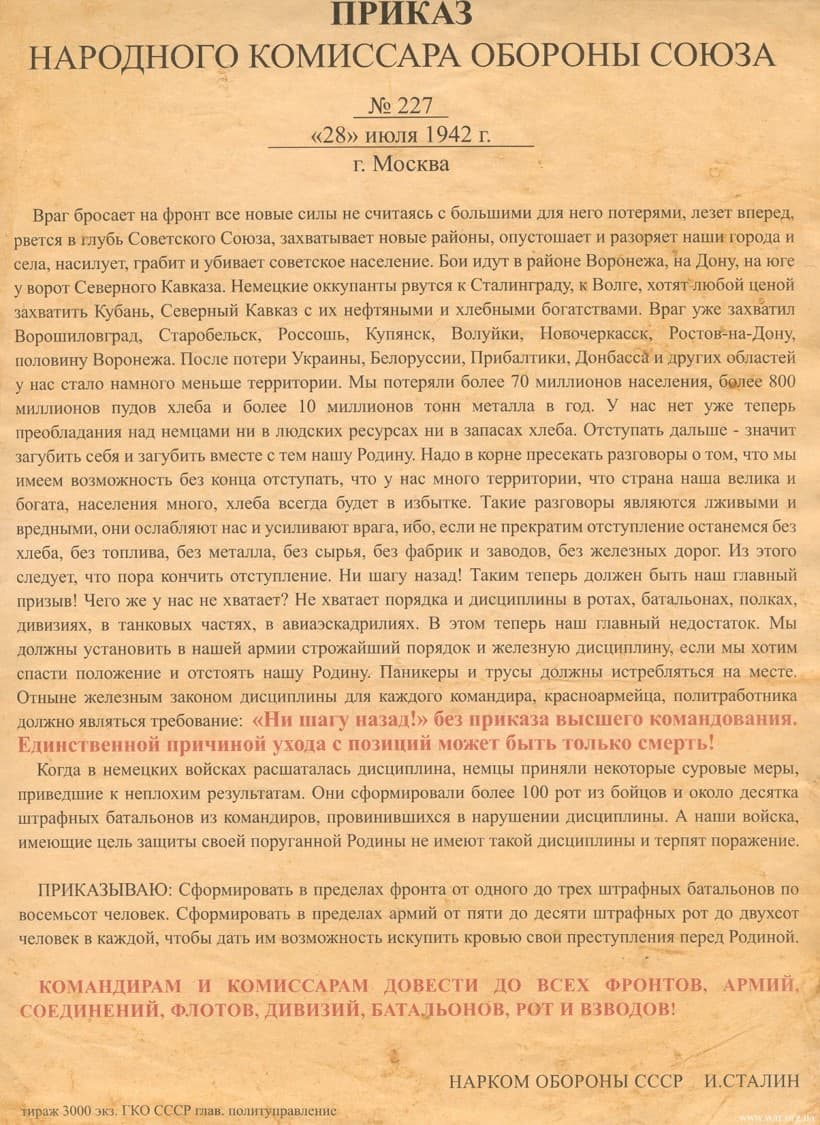 Order No. 227 issued by Stalin on July 28, 1942
After this order, there could be no doubt in the mind of the Soviet soldier: showing reluctance to fight almost certainly meant death.
More than anything, Order No. 227 is characteristic of Stalin's brutal pragmatism. Soldiers were seen as nothing more than disposable entities on the map of battle, their life only worth as much as they could fight for the motherland.
Forcing soldiers to fight despite near insurmountable fear - which was righteous given the nature of the battle - was an easy problem for Stalin, all that needed to be done was to instill in the soldier something they feared more than battle, namely their leader.
Uranus turns the tide
Despite relentless fighting on the side of the Soviets, a breakthrough couldn't be established against the formidable Axis. After a failed counter attack against the northern flank, Zhukov and Vasilevsky (both of whom were very highly ranked within the Red Army) were summoned to the Kremlin on September 12, 1942 to speak with Stalin and explain why the attack had gone wrong. At one point during this meeting, Stalin had begun studying the map of battle showing Stalingrad while both Zhukov and Vasilevsky were in the corner, discussing possible ways of counter attack. They thought Stalin couldn't hear them, but suddenly Stalin shouted across the room: "And what does "another" plan mean?!".
Despite Stalin being notoriously quick to anger, he only ordered the two generals to leave for the general staff to think over their plan.
Coming back the next morning, the two generals presented their audacity: Operation Uranus. The plan was of utmost secrecy, and for the time being, they promised that no one except the three of them in the room would know of what was to come.
Indeed, the enemy never did fully catch on.
And then the clocks hit 5:00 on November 19.
Northern flank Axis soldiers heard what they feared: trumpets signaling the beginning of battle. Next, the ground began to shake. Over a million men had secretly assembled in the thick, freezing mist, and they now were finding out why. Mortars pounded their position indiscriminately, trying to pave a way for infantry to rush through their lines. Scrambling to fight back, they could not have anticipated what was about to hit them.5 Initially, their defense appeared to keep up. The first waves of attack were repelled, but each time they were suppressed, another round came. The waves of the turning tide kept coming, and they were going to win. And win they did.
The defending Romanian army was under-equipped and ill-prepared, and around midday, the Soviets broke through. They began heading south going for an encirclement of the entirety of Stalingrad, all 300,000 Axis soldiers included.6
At this time, the southern strike hadn't begun yet. The only indication being the breakthrough audible across the frozen steppe over 100 kilometers away. Their ground began to shake at 10:00 the next morning. This time, the Soviet breakthrough was even swifter, only taking 45 minutes.7
Less than a half a week after the beginning of Operation Uranus, the encirclement had succeeded. The two encircling armies met near the village Sovetsky around November 22 in what can only be imagined as a moment of utmost joy for the Soviets and utter despair for the Axis soldiers.8 Soviet soldiers in Stalingrad later recounted how the atmosphere had changed after the encirclement. The feeling of victory was visceral.9
The encircled army could now only be resupplied by the Luftwaffe. For an army that was already spread thin due to logistics problems, this was a de facto death blow. And it got worse.
As the Red Army slowly advanced in on the pocket, resupply became ever harder. This culminated when all Luftwaffe occupied airfields had been destroyed, necessitating all resupply happen by airdrop. It was now only a matter of time before surrender. A surrender that came on February 2, 1943.
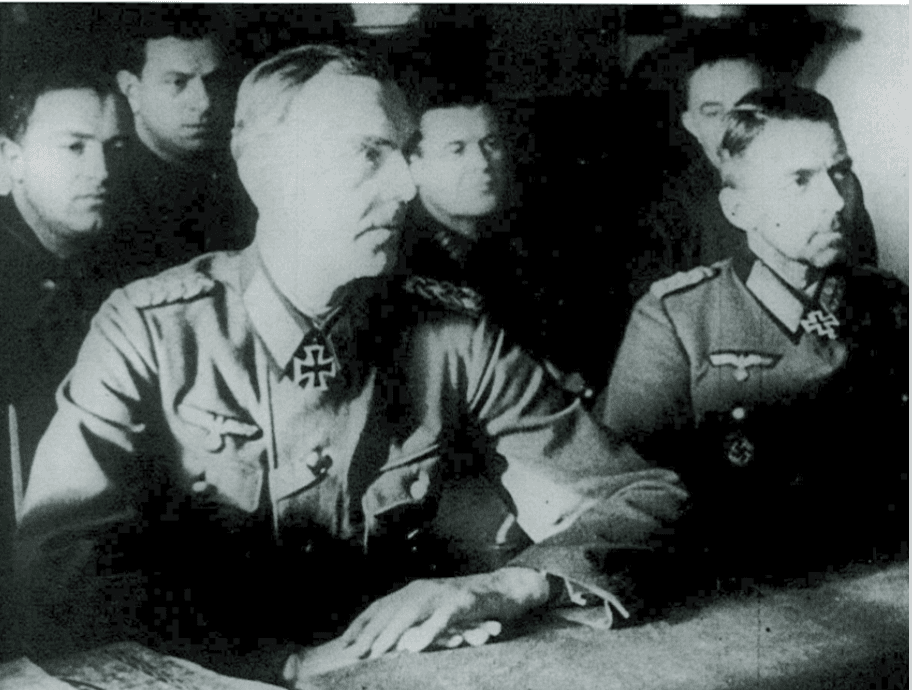 Paulus surrenders on February 2, 1943
Pragmatism
The battle had lasted for 6 months. During this time, over 800,000 Axis soldiers were killed, wounded, captured or missing while over 1,100,000 Soviet soldiers were killed, wounded, captured or missing. This makes the battle of Stalingrad the bloodiest battle in all of World War Two, and likely in all of human history. Over 40,000 civilians would perish during the fighting also10, a number explained by the fact that civilians were explicitly disallowed from leaving during the battle, as Stalin inhumanely believed this would make the defending army fight more vigorously.11
No one bothered about human beings. We too were just meat for the guns
-- boy from Stalingrad trapped in the city11
Soviet ethos towards equipment was also that of disposability and emphasis on quantity of output. From the beginning of the invasion in 1941 to the end of the war for the Soviets, over 122 thousand combat aircraft had been made in addition to 98 thousand tanks and self-propelled guns and close to 20 million rifles. On average during the war, 31% of all combat aircraft and 73% of all tanks and self-propelled guns belonging to the Soviets were destroyed in any given year. Despite this, the Soviets managed to exit the war with more material than when they started.12
These are very impressive numbers when the developmental level of the Soviet Union at the start of the war is taken into account. Many roads in the largest country on earth were simply not paved and given the legendary seasonal mud of the Eurasian Steppe (called rasputitsa in Russian), logistics to the front was a nightmare. Again demonstrating the aforementioned Soviet mindset, anything that worked was deemed to be good enough, however ridiculous it might seem at first. Surprisingly, camels proved indispensable for transporting ammunition, food supplies and even wounded soldiers. One such camel, called Kuznechik, - Russian for grasshopper - even followed the 308th Rifle Division from the battle of Stalingrad all the way to Berlin! Vasily Grossman writes of the camel during his journalistic travels writing for the Soviet Army newspaper Krasnaya Zvezda:
This was a camel called Kuznechik [Grasshopper] in the supply unit of its artillery regiment. This camel, who came from Kazakhstan, has come all the way from Stalingrad to the Beresina. Liaison officers usually look for Kuznechik in the supply unit and do not need other enquiries to find the headquarters which is on the move day and night. We took this unusual advice as a joke and moved on.
The first thing we see when we return to the dust and thundering of the main road is a brown camel pulling a cart. He is almost bald, having lost his hair.
[...] He hides in craters from shells and bombs if there’s a bombardment. He has already earned three wound-stripes and the medal ‘For the Defence of Stalingrad’. The commander of the artillery regiment, Kapramanyan, has promised the driver a decoration if he reaches Berlin with Kuznechik13
Kuznechik became more famous in the end of the war, namely during the Battle of Berlin when it was led across the city to the burning Reichstag to spit on the building.13
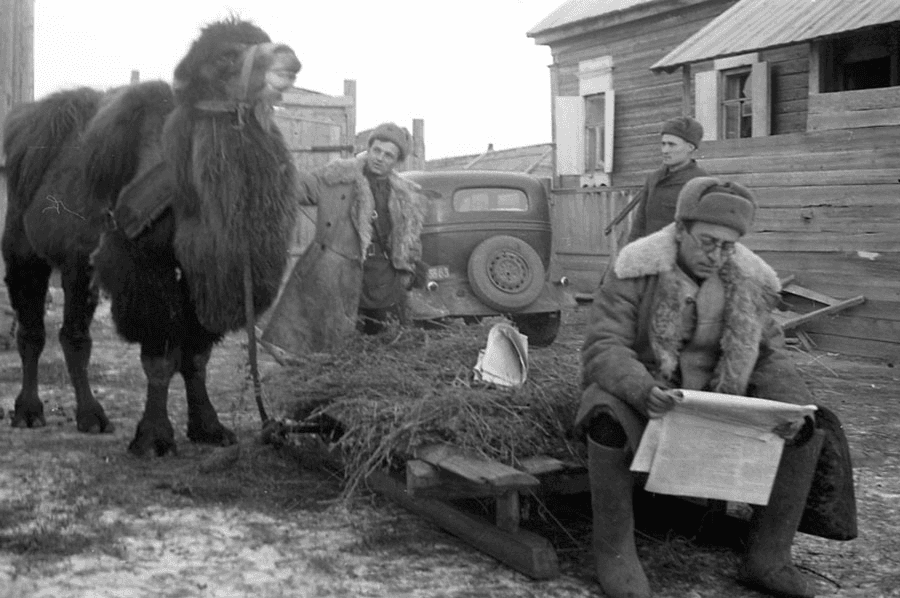 Vasily Grossman next to a camel reading what is presumably the Krasnaya Zvezda. Vasily Grossman popularized Kuznechik the camel through his writings in the newspaper.
The road to Europe
What followed for the Axis after the defeat in the city bearing the Soviet leader's name is a cordial fact for each and every European. From the time the two encircling armies met near Sovetsky on November 22 1942 until the unequivocal defeat of evil on May 8 1945, 898 days of brutal warfare, death and longing for home elapsed. These days, along with all other days of the war, will, like the people who perished, forever be remembered in a free Europe.
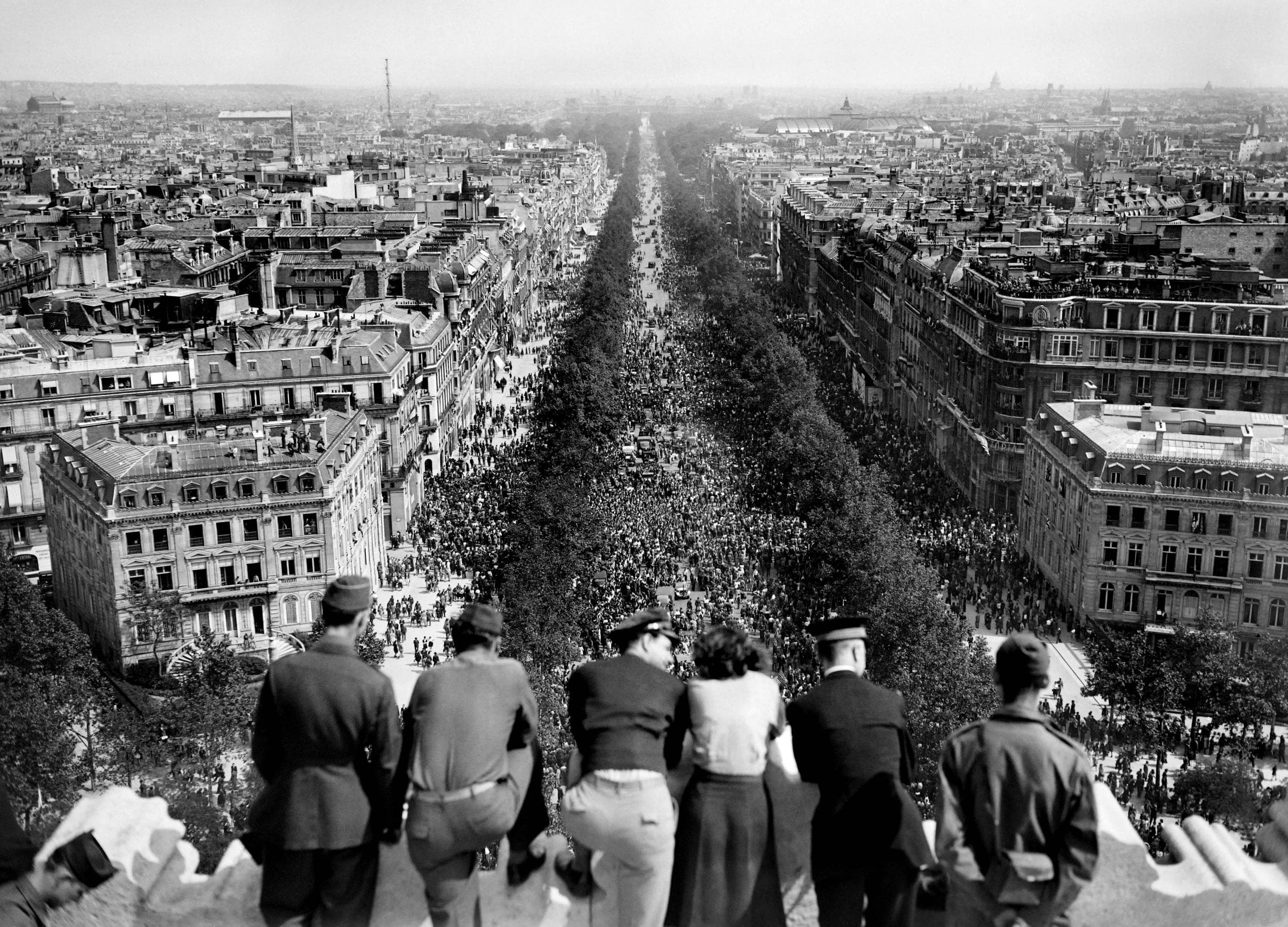 The view from the Arc de Triomphe on May 8, 1945
Disclaimer: I realize this blog post has been very focused on specifically the battle on the eastern front. This is not in any way to degrade any other nations or peoples who fought in the Great War. I will make blog posts about them also at some point in the future
Footnotes
-
Beevor, Antony, Stalingrad (London: Viking Press, 1998), 28–29 ↩ ↩2
-
Zentrum für Militärgeschichte und Sozialwissenschaften der Bundeswehr, Militärgeschichte: Zeitschrift für historische Bildung, Issue 2 (2022), 7. https://web.archive.org/web/20240514073720/https://zms.bundeswehr.de/resource/blob/5460414/55224238ea5625ab5150d0c789d1addf/zmg-2022-heft-2-pdf-data.pdf ↩
-
J. Stalin, "Order No. 227 by the People’s Commissar of Defence of the USSR," Stalingrad.net, https://web.archive.org/web/20250430182120/https://www.stalingrad.net/russian-hq/order-227/peoples-commissar-of-defence.htm ↩
-
Beevor, Antony, Stalingrad (London: Viking Press, 1998), 84-85 ↩ ↩2
-
Beevor, Antony, Stalingrad (London: Viking Press, 1998), 240 ↩
-
"The Battle of Stalingrad: A Decisive Turning Point in WW2," Deutsche Welle (DW), https://web.archive.org/web/20250430182724/https://www.dw.com/en/the-battle-of-stalingrad-a-decisive-turning-point-in-ww2/a-42344954 ↩
-
Beevor, Antony, Stalingrad (London: Viking Press, 1998), 240, 248 ↩
-
Beevor, Antony, Stalingrad (London: Viking Press, 1998), 256 ↩
-
Beevor, Antony, Stalingrad (London: Viking Press, 1998), 240, 264 ↩
-
"Battle of Stalingrad," Encyclopædia Britannica, https://web.archive.org/web/20250430182323/https://www.britannica.com/event/Battle-of-Stalingrad ↩
-
Beevor, Antony, Stalingrad (London: Viking Press, 1998), 106 ↩ ↩2
-
Glantz, David M., and Jonathan M. House, When Titans Clashed: How the Red Army Stopped Hitler (Lawrence, KS: University Press of Kansas, 1995), 306 ↩
-
Vasily Grossman, A Writer at War: Vasily Grossman with the Red Army, 1941-1945, ed. Antony Beevor and Luba Vinogradova (New York: Pantheon Books, 2005), 316 ↩ ↩2